Benchwarmers
A self-hosted panel gateway for LLMs. Ask one of your collections and every model on it answers, side by side; your verdicts pick the next panel.
bench/core: Where can this function return a stale value? At most three short sentences.
def price(item_id, fetch, ttl=60):
now = time.time()
hit = _cache.get(item_id)
if hit and now - hit[1] < ttl:
_cache[item_id] = (hit[0], now)
return hit[0]
value = fetch(item_id)
_cache[item_id] = (value, now)
return value
Panel p20261022-143408-2063 · bench/core · 3 members + 2 explorers · shape: review
member · gemini-3.8-flash · ok · 58.5s
On a cache hit, the function updates the timestamp to `now` without re-fetching the value, resetting the TTL on every access. As a result, if an item is requested at least once within every `ttl` window, the original value will be kept and returned indefinitely.
member · inkling-free · ok · 78.0s
If the system clock jumps backward, `now` can be earlier than `hit[1]`, so `now - hit[1]` becomes negative and falsely `< ttl`. Then the expired entry is treated as valid and `return hit[0]` gives a stale value.
member · nemotron-3.5-super-vl-120b-a12b · ok · 83.8s
Because it rewrites the timestamp on every hit, frequently accessed items can stay cached indefinitely and never expire.
explorer · qwen3.8-27b · ok · 50.8s
A stale value is returned if the calculated `now` is on an older clock than the timestamp stored in the cache. This can occur if system clocks are rolled back or differ significantly across processes using a shared, mutable `_cache`.
explorer 2 · laguna-s-2.1-free · ok · 136.5s
The code updates the cached timestamp on each hit, effectively creating a sliding expiration instead of a fixed validity period since the original fetch.
Verdicts recorded: 3 useful (the timestamp reset on every hit), 2 not (clock rollback, not the bug).
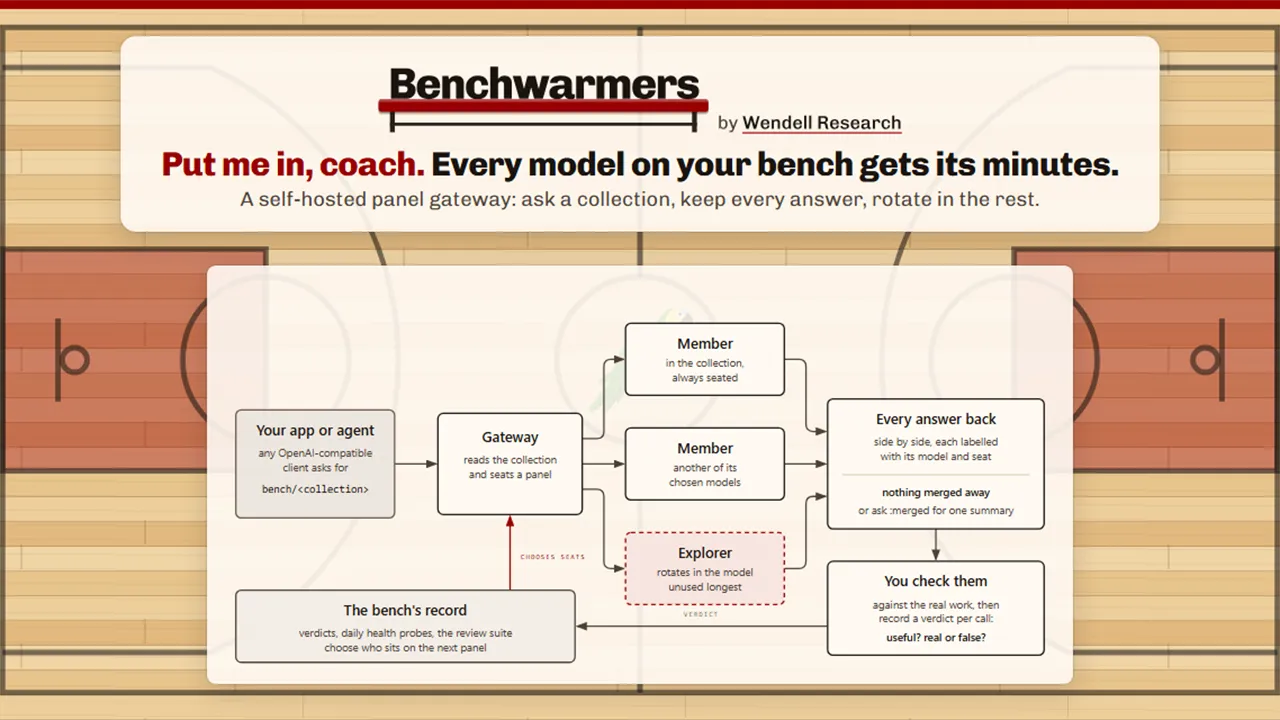
Put me in, coach: every model on your bench gets its minutes. Benchwarmers sits between your apps and the models you can reach, free ones included. An app asks for one of your collections, the models you picked for that kind of work, and the whole panel answers: those members, plus explorer seats that rotate in whichever models you have used least. Every answer comes back side by side, labelled by model and seat, because who said what is the evidence. Nothing is merged away unless you ask.
You check the answers against the real work and record a verdict on each, and those verdicts decide who sits on the next panel. Models are also scored on review work seeded from your own repositories, which no model has trained on, instead of public leaderboards. Daily probes retire the ones that have stopped answering, and rate limits are learned from the providers’ own errors. It speaks the OpenAI API, so any client can ask a panel, and it runs on your machine, from npm, a checkout or Docker, with nothing sent anywhere you didn’t add.
It is a Wendell Research AI project, released as v0.1.